

Content
The PM job search challenge
Product management roles have a unique problem: the same job title can mean completely different things across companies. At one startup, you’re a mini-CEO making strategic decisions. At another, you’re coordinating between engineering and design. At a third, you’re essentially a business analyst who writes PRDs.
This ambiguity makes job searching particularly painful for PMs. You spend hours decoding what each role actually entails, then crafting applications that somehow address wildly different expectations. Meanwhile, you’re competing against candidates who may have learned to game the system better than you have.
Here’s the uncomfortable truth: job searching in product management is a discipline in itself. You can be an exceptional product manager, someone who ships products users love, drives meaningful business outcomes, and leads teams effectively, yet struggle with the job search process. It feels unfair, but it’s reality.
A few years ago, this process consumed weeks of my time per opportunity. I wished I had better tools to cut through the noise and focus on roles where I could actually add value. When it came time to search for a new role recently, I decided to approach it like any PM would: identify the pain points, experiment with solutions, and iterate based on results.
The solution? Generative AI tools used strategically throughout the process.
GenAI can help level the playing field. While everyone now has access to the same AI tools and tricks, what makes the difference is applying product management craftsmanship to use them effectively. The best prompt engineering in the world won’t replace genuine PM experience and judgment, but it can help you showcase that experience more effectively.
I’ll share my recent experience throughout this guide. It’s quite specific: searching in France, targeting tech companies, looking for freelance opportunities in the AI and innovation domain, with 10+ years of experience. Pretty niche circumstances. But I hope the broader principles and practical techniques can be universally applied, regardless of your location, experience level, or target market.
My GenAI job search journey
Let me share what actually happened when I decided to use GenAI for my job search. No polished success story, just the messy, iterative reality of figuring this out as I went.
The starting point: drowning in manual work
My traditional approach was painful. Each application took 2+ hours: decode the job posting, research the company, customize my resume, write a cover letter. I could only manage 2-3 applications per week, and frankly, I was exhausted before I even got to interviews.
When job searching became urgent, I knew I needed to scale differently. I’d been reading about AI tools but felt that familiar PM paralysis: too many options, conflicting advice, no clear starting point.
First experiment: the simplest possible use case
I started embarrassingly basic. Opened ChatGPT, pasted a job posting, and asked: “What are the key points they’re actually looking for?” Then I attached my regular resume and asked it to identify relevant experiences.
It worked... sort of. The analysis was helpful, but I found myself repeatedly uploading the same resume and explaining my background. The process felt clunky, and I realized I needed a better foundation.
Building the knowledge base: a weekend investment
This is where I made my first smart decision. Instead of optimizing the prompts, I invested a full weekend day building what I call my “master resume,” a comprehensive Google Doc with every significant project from my 10+ years, each written in STAR format with quantified results.
I used ChatGPT to help structure these experiences. For each project, I’d explain the context, my role, and the outcomes, then ask ChatGPT to help me format it properly. Instead of “launched a mobile app,” I learned to write “achieved 20% adoption in 4 months versus traditional paper processes.”
The document ended up being several pages long. It felt like overkill at the time, but it became my competitive advantage.
The evolution: from manual to custom assistant
After a few weeks of copy-pasting job postings and attaching my master CV, I discovered custom GPTs. This was a game-changer.
Custom GPTs are personalized versions of ChatGPT that you can create with specific instructions and your own documents as a knowledge base. Think of it like having a specialized assistant that knows your background and has been trained for particular tasks, rather than starting fresh with generic ChatGPT every time.
I created a personalized assistant specifically for job search coaching. Heres the meta part: I asked ChatGPT to write the instructions for my job search assistant. The first version wasn’t perfect, so I went back to the original conversation and gave feedback for improvements.
With my custom GPT ready and my master resume attached as its knowledge base, my workflow transformed. I could paste a job posting and get tailored insights in minutes, not hours.
Real-world results and surprises
The time savings were obvious: 30 minutes instead of 2+ hours per application. But the unexpected benefit was how the AI challenged my assumptions. It pushed me to quantify impact I’d never thought to measure, helped me find connections between experiences I’d overlooked, and consistently asked better questions than I was asking myself.
During interviews, this became a conversation starter. When asked about GenAI experience, I didn’t give generic answers about knowing how to prompt. I shared my screen and showed the custom GPT I’d built, explaining my problem-solving approach. But it wasn’t just one assistant: once I understood how custom GPTs worked, I started creating them regularly. I now build new ones almost every week for my PM work.
Here’s what’s crucial: I never used these tools to fake responses during interviews. I still brought handwritten notes, had physical cards with my experience details written out, and relied on my genuine knowledge during conversations. If I didn’t know something, I said so. If I wasn’t sure about a detail, I admitted it. If I hadn’t thought about doing something differently on a past project, I acknowledged that honestly.
This authenticity matters more than perfect answers. Interviewers can spot fake expertise quickly, they’ve seen enough candidates to recognize when someone is parroting AI-generated responses rather than speaking from real experience. Trying to fake your way through with AI assistance is a guaranteed way to get rejected, often within the first few questions.
The goal was never to appear smarter than I am, but to demonstrate that I could identify problems and build practical GenAI solutions. Suddenly, I wasn’t just someone who’d read about ChatGPT, I was someone who’d identified a problem and built multiple solutions.
The honest reality check
Did I get more interviews? Hard to say definitively, but my response rate felt better. More importantly, the quality of my applications improved because I was applying to roles that actually fit, with messaging that resonated with their specific needs.
The bigger impact came later. The confidence I gained from building this assistant changed how I approached product management work entirely. I started prototyping ideas myself instead of waiting for design resources. I began analyzing data independently rather than queuing requests. AI didn’t replace my PM judgment: it eliminated the bottlenecks that prevented me from moving at the speed of my ideas.
The learning curve: evenings and weekends
I won’t sugarcoat this: becoming effective with these AI tools required personal time investment. Evenings, weekends, trial and error. The landscape moves fast, so staying current is ongoing work.
But here’s my motivation hack: instead of taking generic courses, I focused on specific problems I’d always wanted to solve. Those pet project ideas that had been stuck in my backlog for years? Suddenly they were achievable. When you’re building something you actually care about, the motivation comes naturally.
What I’d do differently
Looking back, I would have specialized my AI assistants more. Instead of one general job search coach, I’d create separate GPTs for role analysis, experience matching, and interview preparation. More focused tools tend to perform better.
I also would have started using tools like v0.dev and Cursor earlier for prototyping. The ability to create functional demos from ideas became incredibly valuable during interviews and in my actual PM work.
The practical implementation guide
This approach worked for my specific situation, but the underlying principles feel universal: use GenAI to scale the tedious parts, invest time in building quality foundations, and focus on enhancing rather than replacing human judgment.
Now, let me show you exactly how to implement this approach.
Step 1: Build your PM master resume
The foundation of an effective job search is what I call a “master resume,” a comprehensive knowledge base of your product management experiences. This document will serve as your primary resource whether you’re crafting applications manually or feeding it to AI tools. While it requires upfront investment, this knowledge base becomes invaluable for quickly identifying relevant experiences and articulating your impact across different opportunities.
Structure each experience using the STAR framework:
Situation captures the context: what product, stage, market constraints, and team dynamics you faced.
Task defines your specific challenge or responsibility: what problems you were solving and business objectives you owned.
Action details your approach: the frameworks, methods, and coordination strategies you employed.
Result documents the measurable outcomes and impact, both quantitative metrics and qualitative improvements.
Beyond documentation, you need a template that captures your complete achievement compactly. This three-part formula works exceptionally well:
Accomplished [X] as measured by [Y] by doing [Z].
This approach doesn’t just show what you achieved: it demonstrates how you achieved it, providing the strategic context that makes your experience memorable and transferable. This methodology comes from a proven article on impact-driven resume writing.
Heres how to build this efficiently. Imagine you recently led a mobile onboarding redesign. Open ChatGPT voice mode and describe your experience naturally: “I led a project to redesign our mobile app onboarding because we had a 60% first-week drop-off rate. Spent three months on user interviews, funnel analysis, design collaboration, and A/B testing. We reduced drop-off to 35% and increased core action completion by 40%. Help me structure this using STAR framework and the impact template. Please ask me questions about missing details to help build this correctly.”
ChatGPT will probe for specifics about team size, timeline, methods, and business impact, guiding you toward: “Accomplished 25% improvement in user retention as measured by first-week drop-off reduction (60% to 35%) by leading cross-functional mobile onboarding redesign, resulting in 40% increase in core action completion.”
Time investment scales with experience. Expect 4-6 hours for 8-12 projects if you have 5+ years of PM experience, or a full weekend day for 15-20 experiences with 10+ years. Using ChatGPTs voice mode makes this conversational rather than a writing exercise, often yielding richer details.
Step 2: Create your custom PM job search assistant
Now comes the fun part: building your personalized AI career coach. Open two ChatGPT tabs because you’ll be working iteratively between them.
In the first tab, ask ChatGPT to design your assistant. Prompt: “Write the instructions for an AI assistant that acts like a product management career coach. It should help me analyze job opportunities, identify my best matching experiences, and provide advice on application approach. Make the instructions detailed and following best practices for custom GPT creation.”
ChatGPT will generate comprehensive, well-structured instructions covering role analysis, experience matching, and application guidance. Read through the output carefully. The first version is usually quite good, but you can refine it: “This looks great, but can you add more specificity about identifying red flags in job postings?” or “Can you emphasize helping me position technical PM experience for growth-focused roles?”
Once you’re satisfied with the instructions, switch to your second tab. Navigate to GPTs and click Create.
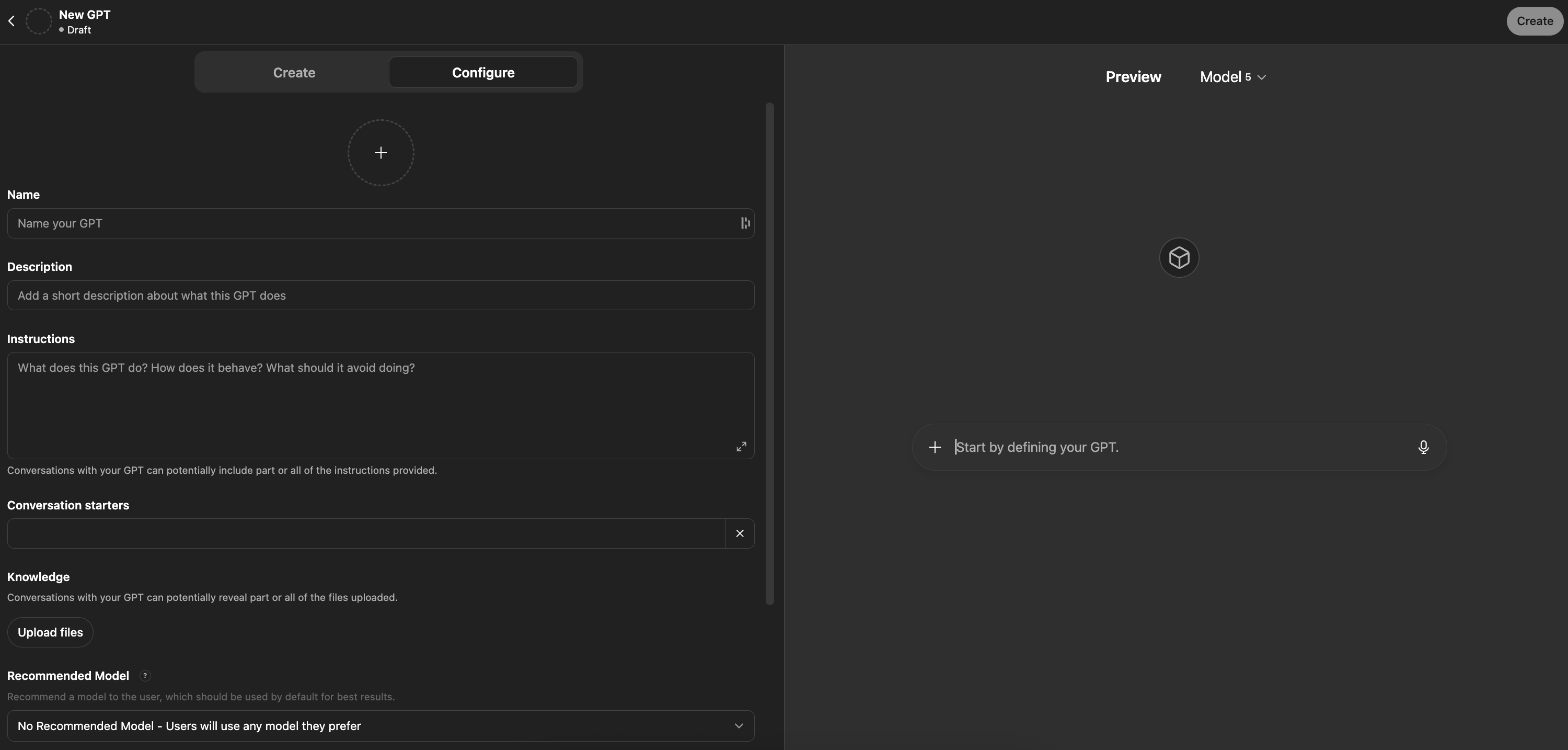
Copy-paste your refined instructions into the instructions field. Give your assistant a clear name like “PM Career Coach” or “Product Job Search Assistant”. Write a concise description explaining it’s purpose. For the profile image, you can ask ChatGPT to generate something professional, maybe a simple icon representing career guidance or product management.
Here’s where the magic happens: upload your master resume document as the knowledge base. Your assistant now has access to all your structured experiences and can intelligently match them to opportunities.
Start testing immediately. Ask questions you’d pose to a real career coach: “Based on my experience, what are my strongest PM competencies?” or “What types of product management roles should I be targeting?” Try more specific queries: “I’m interested in fintech: which of my experiences would be most relevant?”
The ultimate test is job analysis. Paste a real job posting and ask: “Is this role a good fit for me and why?” Follow up with: “How should I approach this application?” and “Which three experiences from my background best align with their requirements?”
Your assistant should provide nuanced analysis, highlighting both alignment and gaps, suggesting how to frame your experience using the company’s language, and identifying which stories from your master resume to emphasize. If the responses feel generic, return to the first tab to refine your instructions and update your GPT accordingly.
Step 3: Transform your job application workflow
Now you have a career coach who knows your entire professional history and can guide you through every aspect of your job search. Think of your custom GPT as a knowledgeable partner who’s always available to help you think through opportunities and decisions.
The beauty is that you can have natural conversations at every step. When you find an interesting role, start by asking your assistant to help you understand what they’re really looking for: “What type of PM role is this and what are the key success factors?” Your coach will analyze the posting and identify whether its a growth-focused position, a technical platform role, or something else entirely.
Once you understand the opportunity, ask for experience matching: “Which of my experiences best align with this role and why?” Your assistant will dig through your knowledge base and suggest the most relevant projects, explaining the connections that you might have overlooked.
For application materials, treat your GPT like a writing partner. Ask it to help you select experiences for your one-page resume: “Help me choose the 4-5 most impactful experiences for this specific role.” Then collaborate on positioning: “How should I frame my fintech experience for this healthcare PM position?” Your assistant can help you translate your background using their industry language and priorities.
Interview preparation becomes conversational too. Ask: “What questions might they ask given this role and my background?” Follow up with: “How should I structure my answer about the mobile app redesign project?” Your coach can help you practice responses and suggest which details to emphasize.
The partnership continues after interviews. Share how it went: “The interview focused heavily on stakeholder management and I felt strong there, but they asked about AI product features and I struggled.” Your assistant can provide feedback, suggest follow-up materials, or help you prepare better for subsequent rounds.
You can even use your coach for broader career guidance: “Based on market trends and my experience, what PM specializations should I consider?” or “How do I position myself for senior roles when I’ve mostly worked at early-stage startups?”
The key insight is treating this like an ongoing conversation with someone who deeply understands your professional story. The possibilities really are infinite: your assistant is available 24/7 to help you think through any job search challenge or career decision.
Your starting point: this weekend
Don’t wait for the perfect timing. Start now:
This weekend: Create your master resume knowledge base, focusing on PM-specific context and quantified outcomes. Use ChatGPT to help structure your experiences around product impact rather than just task completion.
Next week: Build a custom GPT for analyzing PM roles in your target market (B2B SaaS, consumer mobile, fintech, etc.)
This month: Pick one product idea you’ve always wanted to validate and use AI tools to prototype, test, and iterate on it.
What’s one product hypothesis you’ve been wanting to test but haven’t had the resources to validate? How might AI tools help you move from idea to user feedback in days rather than months?
Random thoughts on the bigger picture
The time-to-human-value principle
Heres the critical insight: GenAI should reduce your time to human interaction. Just as in product management, where AI helps users reach core value faster rather than becoming the value itself, your job search AI should accelerate meaningful conversations with hiring managers.
Think of it like optimizing user onboarding: you want to remove friction and irrelevant steps so users can experience your products core value quickly. Similarly, GenAI helps you bypass the resume screening noise to get to substantive discussions about product challenges and your ability to solve them.
This principle extends beyond job searching into how we should implement AI in products. As PMs, we should measure AI features by how quickly they help users reach genuine value: whether that’s connecting with other users, making better decisions, or accomplishing their core goals. The goal isn’t to automate everything, but to enhance the quality and speed of meaningful interactions.
The fundamental shift in PM expectations
The product management role is evolving rapidly, and GenAI is accelerating this transformation. PMs are no longer expected to simply coordinate between teams and write requirements. Organizations now expect us to do significantly more in the same amount of time, and do it with greater autonomy and speed.
Instead of waiting days for design mockups, modern PMs prototype ideas directly using tools like v0.dev or Lovable for user testing. Instead of just describing features, we build functional demos that stakeholders can actually experience. Rather than queuing data requests, we write our own analyses using AI-assisted coding tools like Cursor.
This isn’t just about efficiency gains: its about fundamentally changing what product management means. We’re shifting from coordination-heavy roles to creation-focused ones. From dependency managers to autonomous builders. From process facilitators to rapid experimenters.
The PMs who thrive will be those who can leverage AI to move from idea to validated learning faster than ever before. They’ll prototype and test hypotheses independently, analyze user behavior without bottlenecks, and create AI-powered features that genuinely enhance user experiences rather than just checking a technology box.
But this evolution comes with new expectations. Organizations assume you can handle technical implementation, data analysis, and user research at a pace that was previously impossible. The bar for PM productivity and autonomy has been permanently raised.
Investing in this evolution
Given these shifting expectations, developing AI and technical fluency isn’t optional: it’s table stakes for remaining relevant as a PM. But approach this like any PM skill development: start with real problems you want to solve rather than abstract learning.
Yes, you can begin with courses for foundational knowledge, but quickly transition to concrete projects. That feature idea stuck in your backlog for months? That user research insight you couldnt validate? That competitive analysis you never had time to complete? Use GenAI tools to actually build, test, and analyze these concepts.
Focus on PM-relevant use cases that directly impact your day-to-day work: automating customer feedback analysis, rapid competitive research, user journey optimization, A/B test design, or stakeholder communication improvement. Build authentic differentiation through real artifacts: working prototypes, genuine user insights, or novel problem-solving approaches that cant be easily replicated through prompt engineering alone.
The motivation comes naturally when you’re solving actual product problems rather than completing theoretical exercises. More importantly, you’ll develop the kind of AI-native PM capabilities that organizations increasingly expect.
The coming algorithmic competition
As more candidates use AI to optimize applications and more employers use AI to filter them, were heading toward what The Atlantic aptly compared to the modern dating market: an algorithmic competition where authenticity gets lost in optimization games.
Applicants send out thousands of AI-crafted résumés, and businesses use AI to sift through them. What Bumble and Hinge did to the dating market, contemporary human-resources practices have done to the job market. People are swiping like crazy and getting nothing back.
This creates a peculiar market dynamic: candidates may never receive responses despite being qualified, while employers struggle to find genuine talent beneath layers of AI-polished applications. It’s reminiscent of SEO versus search algorithms: a never-ending cycle of optimization that can obscure rather than reveal true value.
The product management parallel is striking. We’ve seen this pattern in growth metrics: when everyone optimizes for the same vanity metrics, the signals become meaningless. Click-through rates improve while actual user value decreases.
Perhaps were approaching an inflection point where the market will demand more authentic, human-centered approaches to hiring. Just as some dating apps now tout anti-algorithmic approaches and genuine connections, we might see recruitment products that emphasize human judgment and authentic skill demonstration over keyword optimization.
The question for PMs entering this landscape: How do we use AI to enhance rather than replace human discernment? How do we create signals that algorithms can’t easily game? The answer likely lies in building real things: prototypes that work, insights that surprise, solutions that solve actual problems. These artifacts of genuine capability may become the new currency in a world where polished words have lost their meaning.
What’s your experience using AI in your job search or PM work? Have you experimented with custom assistants or automation, or are you still finding your starting point?